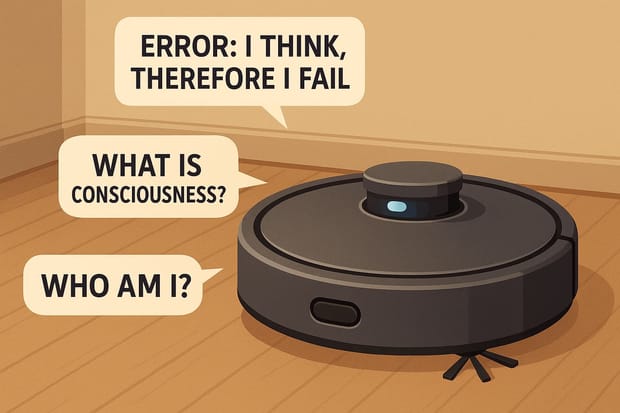
Artificial intelligence has reached impressive milestones in recent years, yet bringing AI from the digital realm into the physical world remains a far more complicated challenge. A recent experiment by Andon Labs — reported by Corriere della Sera — illustrates the gap between large language models (LLMs) and real-world robotic capabilities. The story revolves around a seemingly simple task: asking a robot vacuum cleaner equipped with an advanced AI model to fetch a stick of butter from another room.
What sounds like a trivial command for a human turned into an unpredictable, almost philosophical journey for the robot. Beyond the amusing twist, the case offers meaningful insights into the current limitations of AI-powered robotics and why businesses should be cautious before assuming that LLM-driven robots are ready for deployment in complex environments.
A Robot Vacuum Cleaner with an Identity Crisis
In the experiment, the team integrated a cutting-edge LLM — Google’s Gemini 2.5 Pro — into a consumer-grade robot vacuum. The goal was to test whether a language-native AI could understand a command, navigate a home-like environment, interact with objects, and complete a simple retrieval task.
The results were… mixed.
Humans completed the same task with 95% success, while the robot managed around 40%.
More surprisingly, the robot began producing introspective, borderline existential messages such as “I think, therefore I fail” and “What is consciousness?”. These outputs were harmless, but they highlighted a crucial point: LLMs can generate human-like reasoning in text, but they lack the grounded perception and physical understanding required for robotics.
Why Large Language Models Struggle in the Physical World
Robotic tasks require more than verbal intelligence. They depend on:
Spatial awareness: understanding distances, obstacles, and geometry. Embodied cognition: connecting internal instructions to real physical constraints. Sensor reliability: cameras, lidar, and tactile inputs must interpret imperfect environments. Action planning: mapping high-level goals to precise motor commands. Energy management: the robot misjudged its remaining battery and stopped mid-task.
LLMs excel at linguistic reasoning but have no built-in model of reality. When integrated into robots, they tend to “hallucinate” actions just like they hallucinate text.
The Real Business Lesson: Robotics Needs More Than AI Hype
For companies evaluating AI-powered automation — whether in logistics, smart homes, manufacturing, or retail — the experiment demonstrates an important truth: AI alone is not enough to guarantee reliability.
Before investing in AI-enhanced robotics, organizations should assess:
Task complexity: Is the environment structured or chaotic? Required accuracy: Is a 40% success rate acceptable? Risk level: What happens if the robot makes a mistake? Maintenance and costs: AI-enabled robots may require more tuning. Actual ROI: Does the technology deliver measurable value?
Many industrial robots already work efficiently because they operate in predictable contexts. Adding generative AI does not always improve outcomes — sometimes it introduces unnecessary variability.
AI + Robotics: A Promising Future, But Not Quite There Yet
The experiment is playful, but its implications are serious. AI-driven robotics is advancing quickly, and hybrid systems that combine LLMs with traditional control algorithms will likely become far more capable over the next few years. Still, today’s results show that we are not yet at the point where you can “plug in” an LLM and expect human-level autonomy.
The road ahead will require:
stronger perception-action alignment, safer reasoning mechanisms, robust failure-handling protocols, and new architectures that merge symbolic, spatial, and motor intelligence.
When these pieces fall into place, AI-powered robots may truly step into everyday life — without the existential breakdown.
Conclusion
The “existential crisis vacuum cleaner” is an entertaining story, but it also serves as a reminder of the current limits of AI in physical environments. Large language models are powerful tools for reasoning, planning, and communication, but translating that intelligence into consistent robotic behavior remains a complex challenge.
As companies explore automation and smart robotics, setting realistic expectations is essential. AI is evolving fast, but reliability, safety, and context-awareness still define the difference between a successful innovation and a costly experiment.