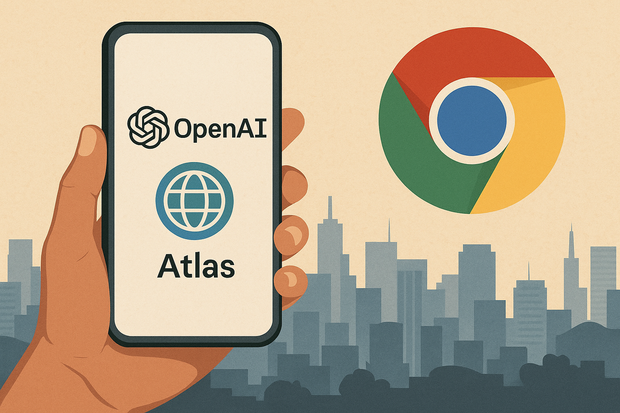
OpenAI Atlas is redefining how we browse the web. The new AI-powered browser from OpenAI marks the beginning of a new Browser War in Silicon Valley — one that will reshape SEO, web traffic, and the very way users interact online. With OpenAI Atlas, artificial intelligence becomes the central force of digital navigation, directly challenging Google Chrome’s dominance.
Silicon Valley’s New Mindset: From Philosophers to Capitalists
Silicon Valley is showing a new face — one that’s pragmatic, profit-driven, and unapologetically capitalist. Gone are the days of tech leaders talking about “meaningful connections” and “changing the world.” Now, the mantra is simple: “We are a money-making machine.”
This blunt honesty marks a cultural shift. Today, if you’re not working with AI, it’s as if you’re not really part of the game. Tech executives embrace exponential progress, insisting that innovation accelerates faster than we can imagine. Even when questioned about massive energy use or environmental impact, they shrug and say, “We’ll find a solution — we always do.”
It’s faith in progress, Silicon Valley style: bold, relentless, and almost religious.
Atlas: The AI Browser That Remembers Everything
The launch of Atlas, OpenAI’s new AI browser, has sparked intense debate across the tech industry. Think of Atlas as a fusion between a traditional browser and ChatGPT — capable of understanding, analyzing, and remembering everything you do online.
Here’s what makes Atlas stand out:
- Conversational Browsing: You can chat directly with the web page you’re on. For instance, ask Atlas to analyze an Instagram page’s engagement rate — it’ll do it instantly.
- Persistent Memory: The real game-changer. Atlas remembers your activity, letting you search your browsing history conversationally — “Find that article about SEO trends I read last month.” Traditional browsers can’t come close.
Despite its innovation, Atlas faces a massive challenge: Google Chrome’s 65% market share. Chrome isn’t just a browser — it’s part of a massive ecosystem (Gmail, YouTube, Calendar) generating $265 billion annually. By comparison, OpenAI’s revenue goal of $12 billion — with an expected $15 billion loss — shows how steep the hill is.
The key obstacle? Switching costs. Leaving Google means abandoning years of integrated data, habits, and services. Atlas will need to deliver something extraordinary to make users switch.
SEO Under Threat: The New Rules of Web Traffic
Artificial Intelligence is shaking the foundations of SEO and online visibility. Tools like Atlas, ChatGPT, and Gemini AI Mode (recently launched in Italy) are changing how users find and consume content.
The data speaks clearly: traditional media sites are bleeding traffic.
- Forbes: -50%
- CNN: -34%
- Fox News: -25%
These outlets relied heavily on search-driven traffic, boosted by Google’s algorithm. As AI chatbots provide direct answers, users no longer need to click links — they get their information instantly.
Meanwhile, community-based platforms are thriving. Substack, for example, has seen a +47% traffic surge, proving that people still seek content they trust and creators they connect with.
For content creators and marketers, the takeaway is simple: SEO must evolve.
Modern content should be written not just for humans, but for LLMs (Large Language Models) that read, understand, and summarize it. Adding specific, natural-language questions at the start of articles can make content more discoverable by AI systems, increasing the chances of being cited or recommended.